
Tamil Vocabulary Cards
A child who knows one word for happy writes the same sentence every time. A child who knows four, and knows which one suits the moment, writes something a marker notices. These free Tamil vocabulary cards are built around that difference.
Log in to open the full set Free for every registered member. No package needed.See inside
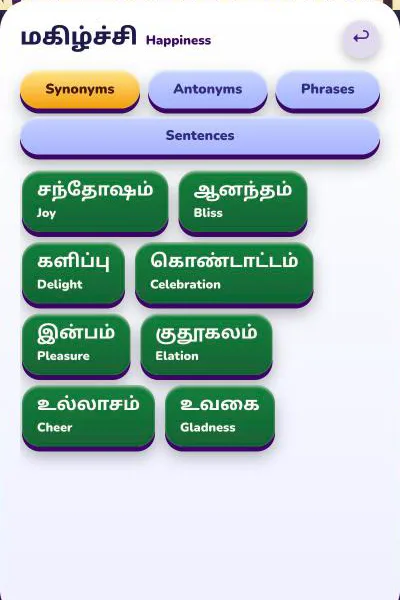
Fifty cards, one theme each. Tap a card and its word tree opens: synonyms, antonyms, phrases and sentences, every word with its English meaning.
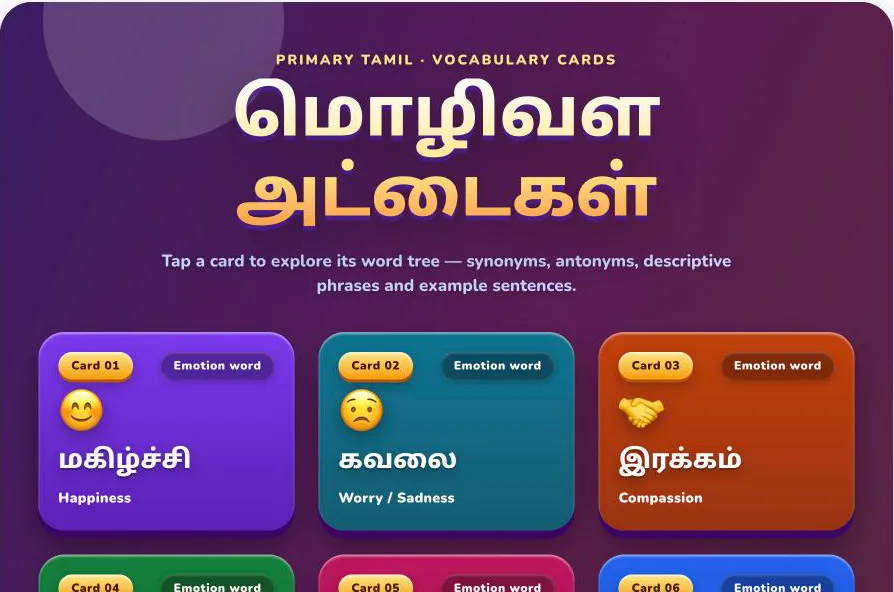
Every card is also a narrated video, so a child can hear each word said properly:
மொழிவள அட்டைகளைப் பார்க்க இலவசமாகப் பதிவு செய்யுங்கள்
Our Tamil vocabulary cards are free for every registered member. Sign in or create a free account to start.
How the cards work
Each card starts from one common Tamil word and opens into a word tree around it. Tap a card and it expands to show synonyms — the near-neighbours that let a sentence be varied — and antonyms, which are often the faster route to remembering a word at all.
Synonyms
The near-neighbours that let the same idea be written more than one way.
Antonyms
Opposites, which are frequently the faster route to remembering a word at all.
Phrases
Short descriptive combinations built from the word, the ones that make writing sound fluent rather than assembled.
Sentences
The word doing real work in context, because a word met only in a list is forgotten by the weekend.
Using them for PSLE Tamil
Two places these pay off directly. In composition, the difference between a plain narrative and a marked-up one is usually word choice, and a word tree is exactly the kind of preparation that shows there. In the oral exam, hesitating while hunting for a word costs fluency marks — the cards build the reach that prevents the pause.
Work a few cards a week rather than many at once, and revisit rather than advancing. Vocabulary responds to spacing far more than to volume, and a word met three times across three weeks is held better than one met ten times in an afternoon.
Composition Practice
Build the vocabulary a picture composition needs, then write it stage by stage.
Composition PracticeTamil Games
Eight short games drilling spelling, word choice and tenses. Five minutes at a time.
Play the games